Future Priests of the Third Millennium

A little insight into the life of seminarians from various dioceses preparing for ministry as Roman Catholic priests, including daily activities, personal interests, special events, the spiritual life, news from the seminary, and almost whatever comes to our minds!


Monday, August 11, 2008

A Constructive Summer - the Saint Paul Statue: the Third Part

Onward we go and full-speed ahead! We are now in the Third Part of the Fifth Installment of A CONSTRUCTIVE SUMMER on the Saint Paul Statue.


We left off yesterday with a hole being dug and a large pile of dirt in the courtyard.


Keep in mind what we're building a structure that will be seventeen feet high (eight feet for the statue and nine feet for the platform). How deep does one need to dig? Well, Ben and I decided to find out.


As soon as the crews finished digging, Ben and I inspected the giant hole in the courtyard of the Saint Paul Seminary. Our first discovery was that there is a large pipe or tunnel that runs underneath our courtyard. These pictues give some perspective on how large the hole really was. Ben went down to inspect the hole first hand.


Having the hole completed and the bottom leveled, the crews began to build the foundation for the pillar that will hold up the statue of Saint Paul.


Here are the basics: it has a cruciform structured base with a solid centre to hold up the eight-foot tall statue of Saint Paul. The pillar and statue will sit in the southwest corner of the courtyard. The statue will face east (toward the rising sun) thus looking towards the entrance of the seminary.


We're moving forward at a fever-pitch pace! Stop by the Web-Log tomorrow to see the progress of the pillar and statue! Stop by the seminary soon to see it in person for yourself.


Take care, -Jeremy


Sunday, August 10, 2008

It's been a while

It has been a while since I last posted. I am now living in Sioux Falls at my parent's house until I move back up to the seminary later on this month. This past week was kind of boring because the majority of my friends are in the working world now and it is tough to get a hold of them sometimes. Between going to Mass and reading and praying there has not been too much excitement. The seminarians for the diocese gathered together for retreat last weekend. It was a good time to spend on retreat. We had a Franciscan hermit (who happened to be a distant relative of St. Pio of Pietrelcina) and the foundress of a Capuchin Monastery in the Scranton, Pennsylvania, Diocese. There were five talks, each of them focusing on things common to the priesthood in both the religious life and the life of the diocesan priest.

This coming week is filled with quite a few things. The one that I have been looking forward to for the longest is taking place at the Carmelite Monastery in Alexandria, SD. About five years ago my friend, Laura Irvine, entered the Carmelite Monastery. Since I was in St. Paul and without a car, I could not get back for the various celebrations (receiving her habit and religious name and her first vows). This coming Friday will be the first time that I have seen her in five years. Please pray for Laura (now Sr. Mary Joseph of the Eucharistic Heart of Jesus) as she prepares for this moment in her life.

The next day a couple of friends of mine will be getting married. I am excited for this wedding, as well, because I will be able to see many people that I have not seen for quite a while.

The last event this coming weekend takes place on both Sunday and Monday. The event is a fundraiser for the Broomtree Retreat Center. Sunday evening there is a banquet including a silent and live auction and Monday there is a golf tournament at the local country clubs. This is a big fundraiser for the retreat center and it is always fun to help with this event.


A Constructive Summer - the Saint Paul Statue: the Second Part

We continue with the fifth installment of the "A CONSTRUCTIVE SUMMER" series. Here we are continuing on the Saint Paul Statue - we could call this "the second part of the fifth installment." Now though that may sound odd, Saint Thomas Aquinas separated his Summa Theologica into four main parts; the second main piece of this document by Saint Thomas was called "prima secundae pars," literally: "the first part of the second part." So, this author believes we can be comfortable with this precedent.


IN THE BEGINNING: Our courtyard was both square and empty before the vision of an eight-foot tall statue of Saint Paul on a nine-foot tall pillar was dreamed for that space. It was decided that the statue would be in the back-left corner of the courtyard and facing the entrance of the seminary.


FIRST THINGS FIRST: If one must build a pillar, then one must first build a foundation. As our courtyard is paved with concrete, the crews first cut and busted the concrete. This author found this first step more entertaining than one might think. Did you ever wonder (even as a child) what the ground underneath your basement looked like? After cutting the borders, heavy equipment was brought in to break and remove the concrete.


After getting to the surface of the earth, the crews then began to dig so that they would have room in which the foundation could be laid. This, naturally, created a large pile of dirt in the middle of our courtyard - the main entrance to the seminary. Though during the "lesser trafficked" months of summer this was a manageable obstacle, this author is thankful that most of the seminarians were away from Saint Paul on summer assignments - should all sixty-plus seminarians have been present while this large dirt-mound was in our courtyard, we may have had the largest sandbox in the Twin Cities!


Completion of this project is set for 15 August and we will be giving you the play-by-play this whole week! Follow the progress daily with us and come to see for yourself.


Take care, -Jeremy


Saturday, August 09, 2008

Saying Goodbye

Sister Carolyn and Sister Olivia have both worked on Cheyenne River Reservation for the better part of two decades. Both are now in their eighties, and both have decided that it is time to retire. It has been a bitter-sweet experience. They look forward to the rest retirement offers. They look forward to living in community again. They look forward to never having to drive the icy roads of Western South Dakota again. And yet, both weep often. Goodbyes are never easy.

The people also weep from time to time. As I meet with the homebound, bringing the Eucharist to them, they tell me stories about the sisters. One tells of the consolation they offered as first one and then a second severely physically disabled daughter died. Others tell me about how sister was there at the baptism of their children. Others describe small gifts and favors received from the sisters. Still others tell about how sister developed a summer bible school that incorporated volunteers from a parish in Wisconsin and teens from the local community to offer some positive summer programming for area children. Over and over they ask, "What will we do without Sister?"

Sister Olivia departed last week amidst tears and hugs and whatall. It was a clean break, and though the parishes in which she operated were pensive last weekend, they were discovering that like it or not, life goes on without Sister.

On Saturday, we celebrated the formal farewell for Sister Carolyn. More hugging and laughing and tears. She still has a few weeks before departing, but this gave the parish community a chance to gather and to thank her as a body. It was a lovely evening, but it exhausted the community and Sister as well.

Goodbyes, it seems to me, despite their difficulty, are a positive experience. Goodbyes are supposed to be hard. How sad it would be to leave a place, a person, a community with whom you had spent twenty years and to feel no pain at the separation. Goodbyes are hard because love has been shared, and it can seem as though a goodbye means the dissolution of that love. Beautifully, though, we believe that where there is love, there God also is. Thus, to say goodbye and to feel that pain becomes a profound experience of the presence of God. Goodbyes are never easy. Thanks be to God.


Friday, August 08, 2008

A Constructive Summer - the Saint Paul Statue: the First Part

We are now turning a new corner in our great, grand, and glorious series: A CONSTRUCTIVE SUMMER! The fifth installment: the Saint Paul Statue.


You may know that the timeless William Shakespeare (you did read Othello, didn't you?) wrote a story that had a play within a play (you did read Hamlet, didn't you?). Taking some inspiration from that we start a series within a series on A CONSTRUCTIVE SUMMER - THE SAINT PAUL STATUE. I must say that I hope that this series within a series won't a be "a comedy of errors!" Ha, ha! You have read Shakespeare, haven't you?


The statue is well on its way to being installed in our courtyard. The current estimated date of completion is 15 August - the Solemnity of the Assumption of Saint Mary. Leading up to that point, we are adding this series within a series to chronicle the step-by-step preparation and installation of the statue. The above picture is the last photograph taken of our courtyard before the major renovations began.


Firstly, to begin this series I must note that this statue is only possible through the extreme generosity of two very kind and Christian people. The same married couple that gave the Saint Paul Seminary its new crucifix hanging in Saint Mary's Chapel now give us, in the Year of Saint Paul, a statue of the patron saint of our seminary, the great apostle to the gentiles: Saint Paul.


This author has had the wonderful privilege of meeting this couple on no less than three occasions and I must say that they are truly wonderful people who live their Catholic values daily and want to support the Church. I would love to introduce them you all of you, our blog-o-sphere friends, however, I have been informed that this couple has elected to remain anonymous.


We are truly grateful for these and all of our benefactors and especially those friends who pray for us. The Saint Paul Seminary could not be successful without the loving support of those who pray for us. Our support has often been described as those who kindly offer their time, talent, and/or treasure to help us, the seminarians. Those who share their time offer in prayer support to Our Lord with us and for us; many people also work for the seminary in various ways to lend-a-helping-hand. Many share their talent in working to support the seminary at our fundraisers, daily operations, and work on various boards and committees for the seminary. Others share their treasure - our donors and benefactors who financially support the seminary.


We're all a team, this is an adventure, and you are all part of it! In addition to this being a huge thanks to our dear friends who are giving us this statue, I would also like to extend this thank you to all who give their time, talent, and/or treasure to support us, the future priests of the third millennium.


Finally, to "get the ball rolling" on this series within a series, I offer these two photos: the artistic and architectural drawings for the pillar and platform on which the statue will sit in our courtyard, and 2) a picture of the statue - custom made by a sculptor in Italy - being packed to be shipped us to here at the Saint Paul Seminary in the mid-West.


Here begins our series within a series!


Take care, -Jeremy


Thursday, August 07, 2008

Brief History of the Roman Rite

Two weeks ago I posted the first of this series, The Extraordinary Form of Mass. There I discussed various titles for this usage of the Liturgy. In this present entry, we will discuss the first stage of the history of the Latin Rite's development. Any who want to argue a particular point, the comment box is always open. All are welcome!

----------------


From the outset of this part, let us clarify some terms. The Latin Rite refers to those Catholics and that cultural and liturgical tradition which has come largely from Rome and currently yet comprises the vast majority of Catholics; one characteristic of this group (our group) is their (our) standard language, Latin. The Gregorian Rite refers to the particular usage and form of the Mass which, by and large, is very similar to that which was codified by Pope St. Gregory in the 7th-8th centuries and is allowed within the Latin Rite yet today; it is also properly called the Extraordinary Form of the Latin Rite. The Pauline Rite will refer to the particular form and usage which was developed and promulgated under and by Pope Paul VI around 1970 and is yet allowed within the Latin Rite today; this is also properly called the Ordinary Form of the Latin Rite.


There is difficulty in discussing the history of the rite of Mass beginning with the very beginning, for in a way, one must begin even before the time of our Lord Jesus Christ. But, that would make this unduly long. There is further difficulty, however. To a certain (some would say large) extent, we do not know exactly what the liturgy looked like in the earliest days of the Church. Some would propose that it looked very much like it looks in the Gregorian Rite pretty much right from the beginning. Others would argue that it looked quite a bit like the Pauline Rite. It would seem that both of these positions are ideologically biased and erroneous. Were there readings from the Scriptures (for first century Jewish Christians this would have been the OT in the Septuagint formulation)? Yes. Were the Psalms sung? Almost undoubtedly. Was there a homily? Of course, though it was merely the interpretation of the Scripture in the light of Christ, as it ought to be today. Was there the recitation of what we now call the Words of Institution/Consecration over bread and wine? Yes, though likely not in the exact verbiage we have today and it probably varied from community to community (cf.Mt 26:26-29, Mk 14:22-24, Lk 22:19-20, I Cor 11:23-25).


Was there the Penitential Rite? Doubtful, though it's not implausible that they would have specifically called to mind their unworthiness. The Kyrie? Nope. The Gloria? Doubtful. The collect? Well, definitely not the formulas we have today, but did they do a prayer to gather their thoughts into one at the beginning of their liturgy? Very possibly. The Creed? Highly doubtful (definitely not Nicene for it didn't exist). Were there intercessions? Possibly. The kiss of peace? Likely. The Our Father? Very possibly, within some communities.


The offertory? Absolutely; there were gifts presented particularly for the poor, but also the bread and wine would be brought as well. Also, there very possibly were the prayers, "Blessed are you, Lord God of the universe . . . " since these come from Jewish prayers; they were the customary prayers which Jesus himself always used, including at the multiplications of the loaves. Did they have a hand-washing? Very possibly, for this was Jewish custom (even though Jesus tells us that only that which comes from without makes us unclean) and their hands were likely dirty, though this didn't necessarily happen at the offertory (and who's to say the offertory didn't happen at the very beginning of their gathering?). Did they have the commemoration of the saints? Highly doubtful, unless they referred to Old Testament greats (Abraham, Melchizedek, Moses, Elijah). Memorial acclamation? Maybe; perhaps something similar to what we have, confessing the tri-fold death, resurrection and expectation of return. Yet, in the same spot and with the same mentality (i.e., just after the consecration)? Doubtful. Did they have the distribution of communion? Undoubtedly. Under both species? Good question, and very debated. For the bishops and celebrant, undoubtedly. For everyone present? In the Corinthian community it seems likely (again, cf. I Cor 11:26-29); we have little evidence for those communities which were not fathered by St. Paul. A dismissal? Almost assuredly. A meal? In the Corinthian community, obviously. In other communities? Saint Paul so quickly deters the Corinthians from it, it seems to be such a specifically Corinthian problem, and he never references the practice (especially a praiseworthy practice) of another community that it is quite possible that other communities did not have a meal with the liturgy or just after.


There's some other details, some of which are highly debated. Let me just present the issues and leave the debate open. Less questionable is the issue of language. For the most part, the language used would have been their common language, Aramaic (a derivative of Hebrew) or Greek, depending upon the community. For some of the prayers (if they were derived from Jewish prayers) may have been in Hebrew. The Scriptures may have been in Hebrew or Greek, though there is some evidence that Jesus used the Greek Septuagint and his disciples likely would have as well. A highly debated issue is the question of location and direction. Where, exactly, did the apostles and first disciples do all of these various parts? Was all of it done in the same room? If not, did they have a separate room with special preparations for the "breaking of the bread"? Who went into this special room? Either way, were they simply gathered? Did they use a table? Did they think of the table as an altar? If so, gather all around it, or did they separate onto two main sides? If so, did they face one another? Did they all face Jerusalem, or the Temple? Did they all face the East? With these issues, we can see from Saint Paul that there most likely was a table used - he refers to the "table of the Lord" and the "table of demons" (cf. I Cor 10:21). As well, the "table of demons" would obviously be the altars used for pagan sacrifice. The question then becomes, however, "Does this mean that Saint Paul understood table and altar synonymously, i.e., the table of the Lord is, for Saint Paul and the Corinthians (at least) an altar?" That's open to debate. These are but two of various issues that are debated.


So, in the beginning, the Mass may have looked different from what we have today in either of the two forms of the Latin Rite. However, the most important elements were always there: readings from Scripture, a homily, the "breaking of the bread" with the words of the Lord, and communion. That these key elements were there and always have been in the Mass will be critical later on in this series. Though, this isn't to say all of these elements happened uniformly among the first Christian communities. Nor even from Mass to Mass within the same community. Nevertheless, as each community began to find its own identity while maintaining that universality which belonged to the Gospel and Christ's body, there would have been a uniformity which did develop. A quote from the 1910 Catholic Encyclopedia article "Liturgy"can be of some help here:


So we must conceive the Liturgy of the first two centuries as made up of somewhat free improvisations on fixed themes in a definite order; and we realize too how naturally under these circumstances the very words used would be repeated -- at first no doubt only the salient clauses -- till they became fixed forms. The ritual, certainly of the simplest kind, would become stereotyped even more easily. The things that had to be done, the bringing up of the bread and wine, the collection of alms and so on, even more than the prayers, would be done always at the same point.

We shall continue with the history in the later Apostolic and Patristic period in the next post.


Wednesday, August 06, 2008

A Constructive Summer - Veranda and Piazza

The fourth installment chronicling our seminary construction projects this summer: the new Veranda and Piazza.


We began this project late in the Autumn of 2007; we often host guests in our hospitality room, which is next to the kitchen of the Saint Olaf room in our basement. Our rector - never at a loss for great ideas - thought it would be wonderful to have a piazza outside of the hospitality room so that our guests could be outdoors as well if we have good weather.


After installing the base tiles late last year, our crews have been able to complete this, our most hospitable project of the summer (please note the PUN on the word "hospitable," as the veranda is paired with out Hospitality Room).


First order of business for the summer project: build a blockade wall between the veranda and the back-lot of the seminary. "Why?" you ask. We have our very standard reasons. Firstly, you may have seen many freeways and interstates where a wall is built to protect a neighborhood from the noise pollution - same idea with our small back parking-lot of the seminary. Secondly, from a visual perspective (if I may editorialize) it adds a certain "class" to the surrounding.


Second order: add a small firepit. "Why?" you ask. To that I say and say again: why not? In fact, Deacon Parrott hosted several seminarians earlier this Summer for a social invent that included a fire in our new firepit. Relatedly, at a House Party this past spring (see our April "House Party" entry in this Web-Log) one of the priests of the seminary was socializing with several seminarians near our then-make-shift firepit; he commented how nice it is to socialize around a fire in the evening. In fact, he jokingly added: "It's good to enjoy a fire with others; that way if we don't get our Eternal Reward, at least we'll be comfortable!"


The finishing touches: add a few woodchips, plants and a fence-border. We finished off this section with some standard plans. Around the verands (which is tile) we added woodchips atop the Earth rather than hope our grass would not wear-out through the ongoing foot-traffic. Then create a border-fence to both keep the woodchips from going too far astray too quickly and to add a sense of closure to the piazza.


It turned out very well. I hope that we will be able to have you as our guests for prayers and an evening on the Veranda sometime soon. However, I must add that we have a safeguard against, shall we say, "unplanned parties." Very sadly we have found that we cannot always trust that things (such as furniture) that we leave outdoors will still be there in the morning. As such, all of our outdoor furniture for the piazza is locked-down until an officially-planned event.


We hope to make you our guest at the seminary and allow you to feel right-at-home in our Piazza and on our Veranda.


Take care, -Jeremy


Tuesday, August 05, 2008

Add one more!

I called up my folks this last Sunday, as is my usual habit. I try to call them once a week. Sometimes I fail at this, but usually I make sure I call at least once every week and a half. Not too much is new with them. They're just having fun being grandparents.

But, I also got in contact with some of my siblings. I'm the youngest of four. These I keep in contact with usually at least once a month. Sometimes it will be more frequent. Usually not less. Well, as I was talking with my brother who is about five years older than I, he handed the phone off to his daughter who is five years old. She and I talked for a short while. She's taking swimming lessons and enjoying them. She thinks I should marry the pool lady, who is 50+ years old and not yet married. Obviously, my niece doesn't understand celibacy. Then, I spoke with her brother, my nephew, who quickly interrupted me because he was so excited and said, "Mom has a baby!" Since he interrupted me, and he's only 2 years old, and he wasn't holding the phone close to his mouth, I didn't quite hear it perfectly and I asked, "What?!" And he said, "I'm gonna be big brother!" And then I knew it must be true, for he wouldn't have understood the idea of being a big brother unless my brother and sister-in-law had explained it to him. Once my brother was back on the phone, I double-checked and sure enough. They're expecting. I guess it's supposed to be a March due date, but she had both of those kids early, so we shall have to see.

But, being an uncle for the seventh time isn't bad. I have been wondering if there might be another one coming along the way sometime soon. Sure enough.


Summer Vistas

The South Dakota Prairie - August - Week I


Monday, August 04, 2008

A Constructive Summer - Backyard Lot

The third installment chronicling our seminary construction projects this summer: The Backlot shared with the Byrne Residence.


Now, perhaps your're thinking, "Really? They're doing a story on the repaving of the back parking lot?" Please remember that this is part of a longer series on the extraordinary number of construction projects going on around the seminary this summer. This author would also like to note that the seminary has a long-range plan and this is all part of said plan.


Those of you who have visited the Saint Paul Seminary might be wondering why this lot does not show up on our list of directions; perhaps you even visited the seminary for an event that left our lot particularly crowded and would have loved to know about this "secret" lot. This lot is reserved for the "upper crust" of the seminary; it leads to a garage where our priest-faculity park, while the lot itself is used by the highest ranking members of the seminary (the transitional deacons and the men of theology three).


People who visit the Archbishop Byrne Residence also use this lot during their stay. The Byrne Residence is the official home for the retired priests of the Archdiocese of Saint Paul and Minneapolis. It is truly our privilege to live next door to these veterans of parish-ministry and we couldn't be happier to be neighbors.


Though you do not need a permit in advance if you're visiting the Byrne Residence, you do need one to park in the seminary section. I should warn you: note the picture on the right with the very large hole: if you park improperly or if you do not have a permit, this (right) is what happens to your car - a lightning bolt from Heaven destroys your car (I am only joking, of course).


The construction here was not a full replacement of the drive - more of some major patchwork. Like all basic tar paths in Minnesota, the very warm summers combined with sub-zero winters wreak havoc on the drive - opening cracks and holes.


This was a straightforward project - the remarkable aspect is just how many projects we are having this summer. Some of my college friends would work on road construction during the summer and I am sure they will be just a bit upset that I cannot remember all the processes they taught me on what these machines are called and how to operate them.


My CONSTRUCTIVE friends will be happy to know that I was watching closely when the team was finishing the project. Again, as with the crews and equipment repairing the outside of the chapel, I persistently asked for a ride in the machines. Sadly, these gentlemen (citing OSHA rules) indicated that they could not give me a ride.


We are very thankful for the hard work of these crews! They worked during several humid and very warm days. I should add that these folks were very courteous and polite to both seminary staff and this author as well.


Here's the story: I didn't know on which date they would be beginning the work on this lot and my car (not pictured herein) was trapped in this back lot. Fretting and fearing that I would not be able to drive for several days, I asked one of these fellas for a favor - to get my car out before it was really too late. I am happy to report that they not only helped me get out but even went out of their way to make sure I had a clear (and safe) path out of the lot as they worked.


Take care, -Jeremy


Sunday, August 03, 2008

Something new

We're trying something new, here, folks.


When I had been only tangently following World Youth Day and the pope's activities there, I had heard a beautiful piece that I wanted to identify. I was unable to do so. I asked some people, but they weren't able to name it, and some that I asked via e-mail never responded. It was used in the WYD Stations of the Cross, the last station. The video is beautiful, and the music perfect. WYD Video of Station 13.


Well, folks, I finally found it. But, it was completely by providence. I usually don't listen to music in the car, unless I'm on an hours-long trip, in which case I bring CDs along and listen to those. Recently, however, I had for some reason tuned into National Public Radio. They play some good classical music, and I think some of you may remember my fascination with music and the power of the human voice. As I was listening, the female disc-jockey's voice came on and announced the next two songs which would close out the radio hour. I didn't listen much to what she was saying, but as soon as she stopped and the next song began, I about hit the roof! I was so surprised and shocked to find that it was the song I was looking for. I burst out laughing because I realized the "coincidence" of it all.


Soon, though, I realized I wasn't any better off. Why? Because I hadn't listened to the woman announce the songs! I didn't know what song it was, and so I was still just as out of luck as before! The song finished, and it continued right into the next song. Finally, about six minutes later the DJ came back on and announced, "Well, folks, thanks for listening in today. You just heard [whatever the song was and by whom] and just before it you heard Andrew Lloyd Webber's Pie Jesu from his Requiem." You can imagine my pleasure at hearing the title. Well, I went and bought it and have been enjoying it.

And here's the new part. For any of you who may desire to preview it, you can listen to the version performed by Sarah Brightman and contained on her album, The Andrew Lloyd Webber Collection in the embedded player below. I think this may be the very recording used during the Stations at WYD, but cannot be sure. Once again, the human voice is so powerful. A clear, stable voice can pierce through the air straight to the heart and move it, as does this song, to plead and cry out for God's mercy.


Pie Jesu,O holy Jesus,
qui tollis peccata mundiwho take away the sins of the world,
dona eis requiem.grant them rest.

Agnus Dei,Lamb of God,
qui tollis peccata mundi,who take away the sins of the world,
dona eis requiem.grant them rest.

Sempiternam requiem.Everlasting rest.


500!!

I must say, I am so pleased with this blog. I just admitted to someone recently that I was quite wary of this whole internet forum. Yet, our recent Holy Fathers have been encouraging us to utilize every form of media and mass communication to go about spreading the Gospel. If this blog, in some little way contributes to that end, I am quite satisfied.

And with that I hereby congratulate Rev. Mr. Tyler who published our 500th post! To Dcn. Tyler who puts in quite a bit of effort (and ends up getting quite a few comments in return), thank you. To you other men who post, thank you. To you readers who follow this blog, support us by your prayers, and hopefully can encourage more men to consider the priesthood, thank you.


Saturday, August 02, 2008

In which I Liken Myself to a Horse

As I grew up on a ranch, I was surrounded by a wide array of animals from my birth. Besides the cattle by which we made our living, there was a steady stream of cats, dogs, sheep for training the dogs, a brief interlude with a pig, a much longer interlude with a goat, and a variety of ponies and horses. Among the horses were two large work horses, both half Belgian as I recall, both mares, and they always seem to stick out in my memory. A whole variety of stories surround these mares, and my father would be happy to tell them sometime; but for me, a two word sentence summarizes my memories: "Walk, girls!"

Our draft mares liked to trot. The reason for this was that, once they had begun to pull whatever load was behind them, they could create a certain amount of momentum by trotting. Then, as long as they could maintain their momentum, they really had to pull very little of the load. To trot made their work easier. For rider and driver, though, it was often unpleasant. Large hay wagons are not designed for trotting horses. They have no seats and no seat belts. The ground over which the horses pull the wagons is rough. As a result, the constant refrain of my father was, "Walk, girls!"

This image came to me recently after I had been speed reading through the Psalms of the Liturgy of the Hours. At the end I realized that I had simply been operating on momentum, so to speak, and failing to really do my work. A lot of people have asked for my prayers. Had I even thought of them? A lot of people are suffering. Had I given them any mention? The Church needs my prayers. Had I actually prayed? I did the office again, much more slowly this time.

The Liturgy of the Hours is, in a way, like a yoke for those who have promised to pray it. The yoke rests on the shoulders of work animals, and is an important piece of equipment inasmuch as it is the means by which an animal carries a load. My yoke, too, draws a burden behind it. In late May, when Deacon Gregory was ordained, his bishop remarked that it was by the Liturgy of the Hours that he would pray for all those who had asked for his prayers and for those for whom he had promised to pray. How true this remark was. I usually pray the Liturgy of the Hours with this thought in mind, but sometimes I realize that I am giving less than they deserve. Unlike the horses of my childhood, I don't have the option of pulling my burden by means of momentum. While it may work for horses pulling a wagon full of hay, if I trot through the Liturgy of the Hours, I will have failed to bear the load at all.


Friday, August 01, 2008

The Space Trilogy

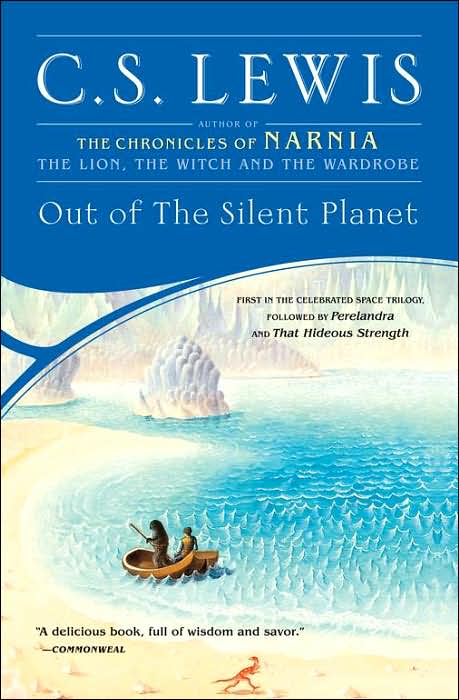
Some of you are probably familiar with C.S. Lewis' Space Trilogy series. The first book is entitled Out of the Silent Planet. It begins on earth and then quickly moves to the planet Malacandra (commonly known on Earth [or "Tellus"] as Mars). The main character, Ransom, is kidnapped from earth and then arrives on Mars with his two kidnappers. He quickly escapes from them, however, and ventures around this planet which is beaming with life. He first suspects this life to be insidious but it is actually completely harmeless. He slowly discovers that he has been taken to a world which is completely (though you'd never explicitly read it in the book this way) innocent, in original holiness and un-fallen. Ransom eventually meets up with other more or less intelligent creatures, but struggles to communicate with them, especially when it comes to ideas which are wholly unknown to that planet. For example, when trying to warn them about the other two humans on the planet, he can't simply tell the Malacandrans that they are evil or bad, he eventually can only tell them that they're "bent."


While on the planet, however, Ransom discovers that all the creatures are knowingly or unknowingly subservient and obedient to the great Maleldil, Oyarsa and eldila. The eldila somehow serve both the creatures of the planet and Oyarsa, but their presence is for the most part unknown. Oyarsa is an eldil, too, but is the chief eldil of Malacandra. Maleldil remains always something mysterious beyond all of these, and greater.


In the end, Ransom's "friends" end up killing a Malacandran creature or two. The eldila eventually remedy the whole situation and send Ransom and his buddies back to earth, while Ransom is in control and the other two are, well, crazy. Crazy because they couldn't hear or understand what Ransom heard and understood, because those two men chose to disbelieve Ransom and chose not to see. Ransom is sent back, in the end, in the same spaceship that he came in (which was then commanded by his captors), but since it was inoperable, it was powered by the eldila through "deep space" back to the Silent Planet, Tellus, Earth.


This raises an interesting point: why did C.S. Lewis choose to call his first book in the series, "The Silent Planet"? How does that fit into the whole plot? Well, as we discover in the book, each planet has its own primary eldil (its own Oyarsa) - Mars' was Malacandra. The eldila can travel from planet to planet, but for the most part, each eldil has command of their planet and other eldila respect that and don't descend without permission of each planet's Oyarsa or the command of Maleldil. Earth is the Silent Planet because its Oyarsa (its primary eldil) turned upon the rest and ceased communication with Maleldil and the rest of the eldila; it went bent. Hence, the book's title refers to the three men's leaving Earth and traveling to Mars.


Obviously, this book is allegorical - though C.S. Lewis may have denied it. It is very effective, however. It is so very interesting how the genius theologian and writer attempts to show the reader how sad our condition is. This first book is largely the encounter between fallen man and an unfallen world, as well as some of an education on angels. In this unfallen world, it is interesting to see how simple relationships are. Lewis does a fine job of trying to show the beauty of obedience and the real simplicity of unfallen innocence - something we sadly never see, not even in children.


Overall, a great read. If you're looking for a Christian novel which is not explicitly theological, yet sound and entertaining, this is your book. So too are the next two books, which I will post on very soon.


Thursday, July 31, 2008

Common Table

Ecce quam bonum et quam iucundum habitare fratres in unum.
Behold how good and how pleasant it is when brothers dwell as one.
- Psalm 133


Fraternity among priests is essential for the well-being of the Church. Indeed, a priest is never a stand-alone. I remember being told in college seminary in Winona that "no priest is a Lone Ranger." As well, though I've never verified this myself, I have been told that only rarely does the Second Vatican Council's document on the priestly (presbyteral) order refer to a priest in the singular. A priest is always ordained into an Order or Society of priests or into a particular (i.e., Diocesan) presbyterate. At an ordination, though only the bishop's laying on of hands is required for validity, all the priests present lay on their hands as well, partially signifying the fact that he is being ordained into a community and not merely as an individual.


In some areas, various fraternities are formed to help priests be priests. In other areas (like the Archdiocese of Saint Paul and Minneapolis) there is an association of priests which is formed and they even live a common life - SPM's being the Companions of Christ. The Church even recognizes the importance of fraternity among priests. The Code of Canon Law states,


Can. 533 §1. A pastor is obliged to reside in a rectory near the church. Nevertheless, in particular cases and if there is a just cause, the local ordinary can permit him to reside elsewhere, especially in a house shared by several presbyters, provided that the performance of parochial functions is properly and suitably provided for.

Notice that word: especially.


Well, though they don't live in one location here in Rochester, nonetheless the pastors have the habit of coming together weekly for an evening of fraternity. This time, "Common Table," begins with socialization for about half an hour, then the Church's Evening Prayer is prayed, sooner or later after that (usually depending upon whether one of the priests has an evening appointment to get to) dinner is served. Sometimes the conversation focuses on completely mundane topics. Sometimes it involves the informing of brother priests of an ill brother priest or ill family member. Sometimes pastors will share wisdom or briefly float an idea by the rest. There's no solid and specific rules to constrict the evening.


Each parish in town takes its turn. If one is to be absent, he simply e-mails the host-priest/parish and lets his regrets be known. The priests gladly welcomed me each week, even calling me when my pastor was gone to make sure I knew I was yet welcome. As I begin to wrap up the summer (I have but a week and a half left), I find that this gathering of the priests was one of the events that I most looked forward to each week. As one not yet finished with seminary and not yet living the priestly life, it is satisfying and reassuring to know of the fraternity and charity shared among priests. In any other setting, you would never find this particular group of men gathering. Their interests are so diverse and their personalities so very different. Yet, there is something that brings them together, something that is greater than each of them individually, and all of them combined. It is the very charity of our Lord and the gift of the priesthood.


Wednesday, July 30, 2008

Martha, Martha, Martha!

Yesterday we celebrated the memorial of St. Martha, sister to Mary and Lazarus, and worker bee extraordinaire. Throughout the day, I followed two lines of reflection.

Firstly, Martha, as compared to her sister, was the doer. She was busily keeping house while her sister chitchatted with Our Lord. It was only after a gentle rebuke from Jesus that she realized that what she really needed to do was sit down and be attentive to the one who had come to spend time with her. I find that I am often like Martha, and though I have gotten better at it, my prayer used to be very much like Martha's behavior. I would go to pray, to be with the Lord, and I find that I wanted to do something. Prayer, I was convinced, was a very active sort of affair, and I struggled tremendously trying to do all the right things, read the right books, recite the correct prayers, and do, do, do. The Lord, on the other hand, was inviting me to sit and relax in his presence. He didn't want me to do so much as he wanted me be with him. I didn't need to say anything. I didn't need to be anything. I just needed to sit there and bask in his presence. Now, I still struggle with this at times, but I have gotten better, and I find that Mary did choose the better part.

A second line of reflection took me in this direction:

Martha, I learned some years ago, is the patroness of single women. I had never really thought about that fact much until today as I was reflecting on her busy-ness. As I did so, I recalled a section from Fr. Benedict Groeschel's book, The Courage to be Chaste, in which he describes the role that a single person can play in his or her family. In many ways, the single person in an extended family becomes the doer. He/she has more time, more freedom, often more financial resources. Thus, the single person lives a life of generosity by giving more of their time than could be expected from a mother and father. Imagine a family dinner that includes all the aunts and uncles and children. It lasts well into the evening. When it ends, who is better able to stay and help clean up? Mom and Dad whose kids are sleepy and cranky, or the unmarried sister? Likewise, who has the car that can most easily fit a helium tank for the birthday party, the SUV with three carseats in it, or the unmarried sibling with the economical Honda Civic? In a way, the single person plays the role of "doer" for his/her family. In this sense, Martha's doing was positive. Even so, the two need to find a balance. The doing and the being need to find a correspondence between one another to strengthen the single person in his/her giving and doing lest he/she begin to feel put-upon and abused.

So, take heart all you Marthas. We appreciate your doing. Don't forget to spend some time at the Lord's feet, though.


Tuesday, July 29, 2008

In which I Rant about Vocations and End on a Positive Note


I have long held that the Church does not face a "vocations crisis." It is true that there are fewer priests now than there were fifty years ago. There are fewer sisters as well. What is not so clear to me, though, is that fewer men are being called. I think that a whole multitude of men are called to the priesthood, but they are not hearing that call, some by design and others by accident of their environment. I have talked to young men who KNOW that they are being called to the seminary, but who refuse to go. They have all sorts of creative excuses. Here is a sampling:

1) Well, I might have a vocation, but I am still discerning whether or not to go to the seminary, so I will just go to college for a few years until I figure it out.

To which I respond (inaudibly, of course), "Good luck. That gnawing pain in your stomach every time you think about priesthood isn't going to go away until you go to the seminary. Enjoy your ulcer."

2) I'm called to the married life.

Really? To whom do you intend to be wed? A call to marriage is a call to lifelong union with a specific other. Who is that lucky lady? At best he can say, "I am not called to the priesthood," but to know that requires that one actually first consider that one is called to the priesthood.

3) I am not worthy to be a priest.

Neither am I. And I never will be. I don't know why God calls who he calls. "It is not you who chose me, but I who chose you." (John 15:16)

4) I think it would get too redundant for me.

Redundant like going home to the same wife in the same house with the same kids and the same ugly couch every day for sixty years? Or redundant like working at a job you don't especially enjoy because the benefits are good, the job is secure, and you will be able to put your kids through college? At the very least, the priest changes assignments every six years or so. And there is nothing redundant about the adventure to which Jesus invites us when he invites us to draw close to himself.

Other young men give me much more compelling answers.

1) I'm afraid. I don't think I can do it.

Well, alone you can't do it. But, "I can do all things in Christ who strengthens me" (Phil 4:3). Do you really suppose he would call you to this and leave you ill equipped to do the job he sets before you? "Cast out into the deep" (Luke 5:4).

2) I want to be a father.

Good! So do I. So should all men. We are all called to fatherhood. It is a question of how we are called to fulfill this vocation to be caretakers, spiritual leaders, and heads of a family. Priesthood is not exclusive of fatherhood. It is fatherhood lived differently.

Indeed, there are a whole variety of excuses, and after you have talked to a certain number of young men, they can begin to get discouraging. So, it is always a great relief when some asks something like, "Hey, Deacon Tyler, were you serious when you told me that you thought I should think about the seminary?" You're darned tootin' I was. When I get a response like that, it typically indicates that this fellow has already been mulling the idea over in his own mind, and is a bit taken aback to hear someone else verbalize his own thoughts to him. In this case, I am always quick to assure him that no one is asking for a lifetime commitment immediately. Just talking out loud about the idea will not prompt the Bishop to lay hands on him the following day. He need not panic. There is lots of time to figure out if the call is authentic. Feel free to call me or ask me about anything. Here is the phone number for the director of vocations.

World Youth Day allowed me to have experiences of both sorts, the encouraging and the discouraging. I suspect that at least one of these young men will be off to the seminary in the fall of 2009. Another may stop going to Church altogether because he is so afraid of the prospect. Nevertheless, to have talked to them was worthwhile. As I mentiond, many young men are trying hard not to hear the call. If someone speaks to them, it is hard to ignore it. Likewise, other young men may not know how to hear the call, and will not until someone speaks to them and suggests that they consider priesthood. So, here are my suggestions for ways that you can help them hear, dear readers.

1) Pray for vocations every day.

2) Look around your parish (the boy servers are a good place to start). If you sense that a particular young man (of any age) might make a good priest, tell him so.

3) Let your sons know that you are open to the idea of them pursuing a vocation to the priesthood. This is especially important for fathers. Your son is unlikely to consider priesthood unless he knows that his dad is going to support the idea.

4) Talk positively about vocations to the priesthood and your own priest(s).

5) Don't be afraid to ask young men if they have thought about entering the priesthood. If you notice something special about them, chances are, they are hearing it too and are doing their best to ignore it. Help them hear. Be persistent, but don't nag. Statistics suggest that a young man needs to be asked at least six times before he will even consider going to visit the seminary. Don't be afraid to say something more than once even though he tries to rebuff you at first.

There is no vocations crisis. There are lots of vocations around. We all have a role to play in helping men realize it.


Monday, July 28, 2008

Blessed Because of the Pure of Heart

"Blessed are the pure in heart" (Matthew 5:8).


The other weekend I was able to spend most of the day with three of my brother seminarians from the Diocese of Saint Cloud. Let me note right away that I won't be giving their names - most of this entry will be about them and I do not want to embarrass them.


During these weeks in the summer, many small towns as well as parishes of Minnesota hold their summer festivals - this is more especially the case in the Diocese of Saint Cloud. At these various small-town summer festivals, the vocation director for the Diocese of Saint Cloud likes to have seminarians attend these events to encourage others to consider serving the Church through their vocational call - an advertisement, really.


The highlights from this particular day included a volleyball tournament (the seminarians had our own team AND our own uniforms - try to beat that), an outdoor Mass (my first "polka Mass"), and interaction with the crowds at the downtown party and main festival. I could tell many great stories about the day's events, such as: the young men we met who could be great priests, the little girls who thought it would be cool to be nuns, and the very kind folks who were so happy to see that the Diocese had an increasing number of seminarians.


However, I would like to write to you regarding my brother seminarians. As I wrote above, one of the main events of the day was a volleyball tournament; we spent most of our time here because of the sheer number of people moving through the area.


On occasion, we (the seminarians present) would have a break from playing volleyball and chatting with the crowds around us and were able to just hang out with one another. It is here that I gained a full understanding of how fully Christian and pure of heart are these men with whom I am privileged to work. Their lives are centered around Christ and His call, they treat all whom they meet with great compassion, and (clearly) have pure hearts.


I have always known this - even from the moment I met them - but it is only now that I fully appreciate how fortunate I am to be "on the same team" as these great men. Should these seminarians of which I write be chosen for ordination, blessed indeed will be the Diocese of Saint Cloud and the whole Church.


We are able to learn from the example of Christ as well as the saints. As we follow their example, we can also see those who now walk among us are examples of how to live, work, act, and be fully a Christian. I will always continue to learn such virtues.


"Create in me a pure heart, O God, and renew within me a steadfast spirit" (Psalm 51:10).


Take care, -Jeremy


Sunday, July 27, 2008

One more week

This coming Friday will be my last day in the parish. It seems like it was just yesterday that I had moved in. Over the past two months I have spent time at the local hospital and nursing homes, read a few books (in the middle of a couple right now), helped run a summer youth program called 'Totus Tuus', met several great families, painted lines for the parking lot, and the list goes on. One of the most important things that I have learned this summer is to be ready for what may come during the day. For me to be ready, I ought to be praying with a pastor's heart. I have also learned to be present to those who are in most need and to reflect the love of God to them. The priest that I have been living with has been a good model for me and has become a good friend. As my time in Milbank draws to a close I look forward to my next parish assignment and also to a new academic year. There are more things to learn as the years go by, but this has been a good start to a life-long learning process.


Saturday, July 26, 2008

That was fun; let's not do it again.

The day began, as is my rule, the Office of Readings and Morning Prayer. Since I wasn't participating in the daily mass at the parish, here, I didn't go over there to do my holy hour in the morning. So, then I had some breakfast and did some reading. Then, it was off to the nursing home for 10:00 AM mass. Mass was great. The elderly were lovely; they always are. And this Mass is awesome: so many parishioners show up to help with the mass and visit with the people there that it is truly inspiring. There are probably 9 parishioners who show up, four of them being from one family (a mom [dad was gone this week on a business trip] and kids in grades 9, 7 and 5, or so). I gave the homily, speaking about the humility of Solomon and the joy of the one who works to obtain the treasure (we have the habit of using the Sunday readings on Saturday morning at the nursing homes).


Then midday was fairly uneventful. I did some reading, ate lunch, finished my homily preparation, until 3:07 when I received a call in my room from the sacristy. "There's a baptism during the 4:00 mass and Father wants you to know, in case you want to make your homily shorter since there's a baptism." Great! Knowing the parish, knowing the pastor and being a deacon, I knew this meant I didn't have enough time to prepare and something was going to get short-changed.


Why wouldn't there be enough time? All I had to do was adapt my homily a little, right? Well, not quite. You see, being a deacon, I get to function very much as the MC at my parish. As well, the pastor likes to do things correctly, as they are in the text, and this parish rarely does baptisms during Mass. I myself haven't practiced or assisted at a baptism during Mass, except at the Easter Vigil, but that's different. So, I had to first learn how to do the baptism during mass, then modify the general intercessions from the weekend for use at baptism, make sure the family knew to be ready at the beginning, middle and end of mass, make sure blessed water was out and ready along with everything else, remind Father of how this all went, remind the lector that I would carry in the Book of the Gospels, tell her to come up right after the homily for the General Intercessions (we're letting the lector do that here rather than [perhaps more appropriately] the deacon), tell the choir director that the Gloria comes right after the initial questioning of parents and godparents, find out that the choir would be doing an acclamation after the baptism, vest and prepare myself for the celebration of Holy Mass. Oh, and don't forget that I yet had to adapt my homily.


Like I said, something had to get short-changed. Well, about four things did: the intercessions, the instruction of the lector, the homily, and my preparation for Mass. Sadly, I have the suspicion that this might be a fairly common occurence in parishes, especially hispanic parishes with someone asking for a presentación of their toddler just before mass or whatever have you. Perhaps I'm wrong about the situation of parishes, and I hope I am! Yet, I don't get too discouraged or disappointed with myself in this situation. Such were the circumstances. We make the best of the situation, confess our negligence, and trust God with the rest! In the end, the Baptism and Mass went well: the little girl was made a daughter of God and welcomed into the family of the Church, and the sacrifice was re-presented unto the Most High. Deo gratias!